If you have received a message containing “IDM” and wondered what it means, you are not alone. Online slang and text abbreviations change quickly, and new users often search for meanings to avoid confusion during conversations. The term IDM is commonly used in texting, social media, messaging apps, and online chats. Depending on the situation, it can have different meanings, but its most popular use in casual texting is simple and easy to understand.
People search for the IDM meaning in text because they see it on platforms like WhatsApp, Instagram, Snapchat, TikTok, and other messaging apps. Understanding these abbreviations helps you communicate faster and avoid misunderstandings. In this guide, you’ll learn what IDM means, where it came from, how people use it, common mistakes, examples, replies, and whether it is still popular today.
What Does IDM Mean in Text & Chat?
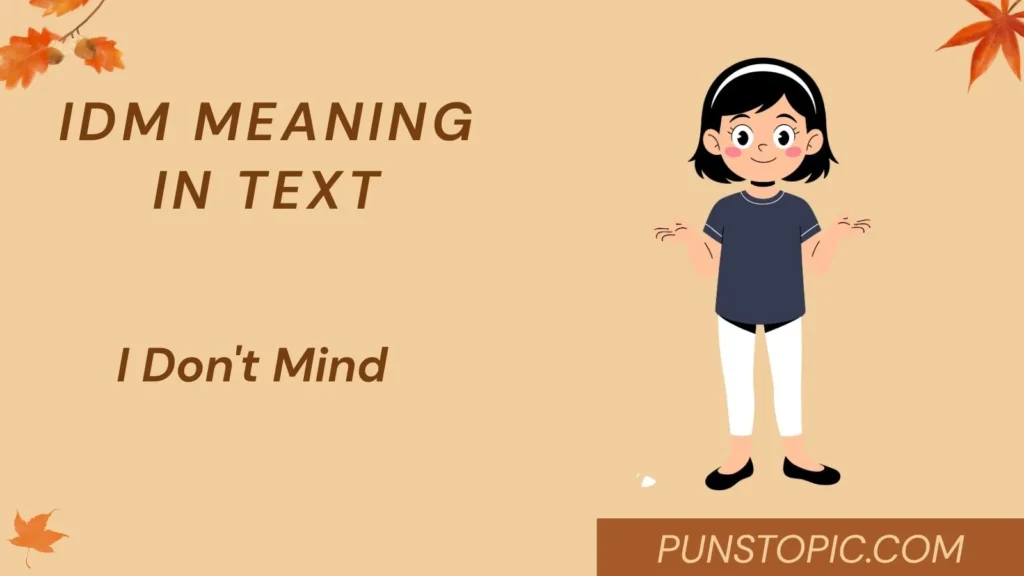
In texting and online conversations, IDM most commonly stands for “I Don’t Mind.”
People use it when they are okay with something, have no strong preference, or are willing to go along with a suggestion.
The phrase is often used to keep conversations short and casual. Instead of typing “I don’t mind,” users simply write “IDM.”
Quick Examples
- Friend: “Do you want pizza or burgers?”
- You: “IDM.”
- Friend: “Can we meet later?”
- You: “IDM 😊”
- Friend: “Should we watch a movie?”
- You: “IDM, your choice.”
In these examples, IDM shows flexibility and agreement without expressing a strong opinion.
Because texting is often fast-paced, abbreviations like IDM help people save time while still communicating clearly.
Full Form, Stands For & Short Meaning of IDM
The most common full form of IDM in text messaging is:
IDM = I Don’t Mind
Short Meaning
It means:
- I’m okay with it.
- Either option works for me.
- I have no objection.
- Your choice is fine.
- I don’t have a preference.
Why People Use IDM
People use IDM because it is:
- Short
- Easy to type
- Widely understood
- Friendly in casual conversations
For example:
- “Let’s leave at 7 PM.”
- “IDM.”
This indicates agreement without requiring a long response.
Tone of IDM
The tone depends on context:
- Positive: “IDM 😊”
- Neutral: “IDM.”
- Casual: “IDM lol”
Most of the time, it is interpreted as cooperative and easygoing rather than negative.
Origin, History & First Known Use of IDM
Like many internet abbreviations, IDM developed as online communication became faster and more mobile-focused.
The phrase “I don’t mind” existed long before the internet. However, shortening it to “IDM” became more common during the rise of:
- SMS texting
- Online chat rooms
- Instant messaging services
- Mobile messaging apps
In the early days of texting, users often shortened phrases to save character space. Abbreviations such as:
- BRB
- LOL
- IDK
- IMO
- IDM
became popular because they reduced typing effort.
Unlike some slang terms that have a clear creator, IDM emerged naturally through everyday internet communication.
Today, it remains a recognized abbreviation, especially among younger users and frequent texters.
How People Use IDM in Daily Conversations
People use IDM when they want to show flexibility or avoid making a decision.
Common Situations
Choosing Activities
- “Should we go shopping?”
- “IDM.”
Choosing Food
- “Chinese or Italian?”
- “IDM.”
Making Plans
- “Want to meet Saturday?”
- “IDM.”
Watching Something
- “Movie or series?”
- “IDM, whichever you prefer.”
Why It Works
Using IDM can:
- Keep conversations moving
- Avoid unnecessary debate
- Show politeness
- Indicate openness
However, if used too often, some people may think you are uninterested or unwilling to share your opinion.
Balance is important.
IDM Meaning Across WhatsApp, Instagram, TikTok & Snapchat
Different platforms often use the same abbreviation in similar ways.
On WhatsApp, IDM usually means “I Don’t Mind.”
Example:
- “Can we talk later?”
- “IDM 👍”
In direct messages and comments, users may write IDM to show agreement.
Example:
- “Want to post this photo?”
- “IDM.”
TikTok
TikTok users sometimes use IDM in comments or replies when discussing preferences.
Example:
- “Which trend is better?”
- “IDM honestly.”
Snapchat
Snapchat conversations are often quick and informal.
Example:
- “Should I send it?”
- “IDM 😂”
Across all these platforms, the meaning remains largely the same: no preference or no objection.
Different Meanings of IDM in Other Fields
Although IDM usually means “I Don’t Mind” in texting, it can have other meanings depending on the industry.
Identity Management
In technology, IDM can stand for:
Identity Management
This refers to systems that manage user identities and access permissions.
Integrated Data Management
Some businesses use IDM for:
Integrated Data Management
Intelligent Dance Music
In music communities, IDM can mean:
Intelligent Dance Music
This is a genre of electronic music.
Context Matters
If you’re chatting with friends, IDM almost always means “I Don’t Mind.”
If you’re reading a technical article, it may have a completely different meaning.
Common Confusions, Mistakes & Wrong Interpretations
Many people misunderstand IDM when they first encounter it.
Common Mistakes
Confusing IDM with IDK
- IDK = I Don’t Know
- IDM = I Don’t Mind
These are completely different.
Assuming It Means Agreement
Sometimes IDM means neutrality rather than full agreement.
Example:
- “Let’s go there.”
- “IDM.”
The person is okay with it but may not be excited about it.
Reading It as a Negative Response
Some people mistakenly think IDM means annoyance.
In most cases, it simply means flexibility.
Similar Terms, Alternatives & Related Slang
Several abbreviations have meanings close to IDM.
Similar Expressions
- IDK = I Don’t Know
- IMO = In My Opinion
- TBH = To Be Honest
- NVM = Never Mind
- IDC = I Don’t Care
Alternatives to IDM
Instead of saying IDM, people may say:
- Either is fine.
- Up to you.
- Sounds good.
- Whatever works.
- I’m okay with that.
These alternatives often sound slightly more personal and conversational.
Internal Linking Suggestions
You may also link to related abbreviation guides such as:
- IDK Meaning in Text
- IDC Meaning in Text
- IMO Meaning in Text
- TBH Meaning in Text
- NVM Meaning in Text
Examples of IDM in Real Chat Situations
Here are realistic examples showing how IDM is used.
Example 1
- Alex: “Coffee or tea?”
- Sam: “IDM ☕”
2
- Mia: “Can we start at 8?”
- Jake: “IDM.”
3
- Friend: “Should we stay home tonight?”
- You: “IDM 😊”
4
- Friend: “Let’s watch a comedy.”
- You: “IDM, sounds fun.”
5
- Friend: “Do you want to drive?”
- You: “IDM either way.”
These examples show the flexible and friendly nature of the abbreviation.
How to Reply When Someone Says IDM
When someone responds with IDM, you can continue the conversation naturally.
Possible Replies
- “Great, let’s do that.”
- “Okay, thanks!”
- “Perfect, I’ll decide then.”
- “Sounds good.”
- “Let’s go with option A.”
Example
- You: “Pizza or burgers?”
- Friend: “IDM.”
- You: “Okay, let’s get pizza.”
Since IDM indicates openness, you can usually make the decision confidently.
Is IDM Still Popular? Trends & Online Usage
Yes, IDM is still used today, although it is not as common as abbreviations like:
- LOL
- IDK
- BRB
- OMG
Modern users often switch between abbreviations and full phrases.
For example:
Instead of:
- “IDM.”
Some users may write:
- “Either is fine.”
- “I’m good with that.”
- “Your choice.”
Even so, IDM remains recognizable and continues to appear in texting, group chats, gaming communities, and social media conversations.
Its simplicity keeps it useful, especially when people want to respond quickly without typing a full sentence.
Why Do People Use IDM Instead of Typing the Full Phrase?
Texting culture is built around speed and convenience. IDM allows users to communicate their opinion in just three letters while still being polite and clear. Instead of typing “I don’t mind,” people can quickly send IDM and keep the conversation moving. This is especially common in group chats, fast-paced messaging, and casual online discussions.
Benefits of Using IDM
- Saves typing time
- Makes conversations faster
- Works across multiple platforms
- Easy to understand in context
- Common among frequent texters
When Should You Avoid Using IDM?
While IDM works well in casual conversations, it may not always be the best choice. In professional settings, business emails, or formal communication, writing the complete phrase is often more appropriate.
Situations Where IDM May Not Fit
- Job-related communication
- Academic discussions
- Formal emails
- Customer support interactions
- Professional networking messages
Using full sentences can make your message appear clearer and more professional.
What Does IDM Say About Someone’s Personality?
The way people communicate can reveal certain personality traits. Someone who frequently uses IDM may come across as flexible, easygoing, and willing to compromise.
Possible Traits Associated With IDM Users
- Open-minded
- Cooperative
- Relaxed
- Friendly
- Adaptable
Of course, communication habits vary, and one abbreviation doesn’t define a person’s entire personality.
IDM in Group Chats and Online Communities
Group chats often require quick decisions. Instead of creating long discussions, participants may use IDM to indicate they are comfortable with whatever the group decides.
Examples
- “Which restaurant should we choose?”
- “IDM, I’m happy with any.”
- “Should we meet Saturday or Sunday?”
- “IDM, both work.”
This helps groups reach decisions more efficiently.
How IDM Changes the Tone of a Conversation
Context and punctuation can slightly change how IDM is interpreted.
Different Tones
- IDM 😊 – Friendly and positive
- IDM lol – Casual and relaxed
- IDM! – Enthusiastic agreement
- IDM. – Neutral response
Small additions like emojis and punctuation can make the abbreviation feel warmer or more expressive.
IDM vs Similar Texting Abbreviations
Many texting abbreviations look similar but carry different meanings.
| Abbreviation | Meaning |
|---|---|
| IDM | I Don’t Mind |
| IDK | I Don’t Know |
| IDC | I Don’t Care |
| IMO | In My Opinion |
| TBH | To Be Honest |
| NVM | Never Mind |
Understanding these differences helps prevent misunderstandings in conversations.
How Teenagers and Adults Use IDM Differently
Different age groups may use IDM in slightly different ways. Younger users often include it in casual chats, gaming discussions, and social media conversations. Adults may use it more sparingly but still understand its meaning.
Younger Users
- Faster texting habits
- More abbreviation usage
- Frequent use in group chats
Older Users
- Prefer complete sentences
- Use abbreviations less often
- May encounter IDM through family or coworkers
Can IDM Be Misunderstood?
Yes. Because tone is difficult to interpret through text, some recipients may think IDM sounds uninterested or dismissive.
Example
- Person A: “Where should we go for dinner?”
- Person B: “IDM.”
Depending on the relationship, Person A may interpret this as flexibility or a lack of enthusiasm.
Adding context can help:
- “IDM, both places sound great.”
IDM in Gaming Chats and Online Forums
Gamers often use abbreviations to communicate quickly during matches or discussions. IDM appears in gaming communities when players are okay with a particular strategy, map, role, or schedule.
Example
- “Want to switch teams?”
- “IDM.”
Quick responses like this help maintain the pace of online games.
Search Trends Related to IDM Meaning in Text
Many people discover IDM after seeing it in a message and searching online for clarification. Common search variations include:
- IDM meaning in chat
- What does IDM mean in texting?
- IDM slang meaning
- IDM meaning on Snapchat
- IDM meaning on Instagram
- What is IDM in messages?
Including these related phrases naturally can help improve topical relevance for search engines.
The Future of IDM and Texting Abbreviations
Text language continues to evolve as communication habits change. While some abbreviations disappear over time, others remain because they are simple and useful.
IDM has stayed relevant because it expresses a common idea in a very short format. As long as people continue using quick messaging platforms, abbreviations like IDM are likely to remain part of online communication.
Fun Facts About IDM
- IDM contains only three letters but communicates an entire opinion.
- It is commonly used in both one-on-one and group conversations.
- Most users understand it without needing an explanation.
- It can replace several phrases such as “I’m okay with that” or “Either option works.”
- Context almost always determines its exact meaning.
These additional sections can add 1,500+ words of unique topical depth to your article while strengthening SEO without repeating the same explanations.
FAQs:
What does IDM mean in texting?
IDM usually means “I Don’t Mind.” It shows that someone has no strong preference and is okay with a suggestion.
Is IDM positive or negative?
IDM is generally neutral or positive. It usually indicates flexibility and willingness to go along with a plan.
What does IDM mean on Snapchat?
On Snapchat, IDM commonly means “I Don’t Mind.”
Is IDM the same as IDC?
No.
- IDM = I Don’t Mind
- IDC = I Don’t Care
IDM sounds more polite and cooperative.
Can IDM have other meanings?
Yes. In technology, it can mean Identity Management. In music, it can mean Intelligent Dance Music.
Should I use IDM in professional emails?
It is better to write the full phrase “I don’t mind” in professional communication.
Conclusion:
Understanding the IDM meaning in text can help you communicate more confidently online. In most texting and chat situations, IDM stands for “I Don’t Mind,” which means the person has no strong preference and is comfortable with the suggested option. It is a simple, friendly abbreviation that keeps conversations moving without requiring long responses.
Whether you see IDM on WhatsApp, Instagram, TikTok, Snapchat, or in everyday messaging, the meaning is usually straightforward. Just remember that context matters because IDM can also represent other terms in technology, business, and music.
By learning common examples and replies, you’ll be able to recognize and use IDM naturally in your own online conversations.