If you’ve recently received a message containing IDTS and wondered what it means, you’re not alone. Internet slang changes quickly, and new abbreviations appear across texting apps, social media platforms, and online communities every day. One acronym that often confuses people is IDTS.
People search for the IDTS meaning in text because they see it in conversations on WhatsApp, Instagram, Snapchat, TikTok, and other messaging platforms. Understanding these shortcuts helps you communicate faster and avoid misunderstandings.
The good news is that IDTS is easy to understand once you know its meaning and context. In most cases, it expresses doubt, disagreement, or uncertainty in a short and casual way.
This guide explains the full meaning of IDTS, where it came from, how people use it, examples from real conversations, and whether it is still popular today.
What Does IDTS Mean in Text & Chat?
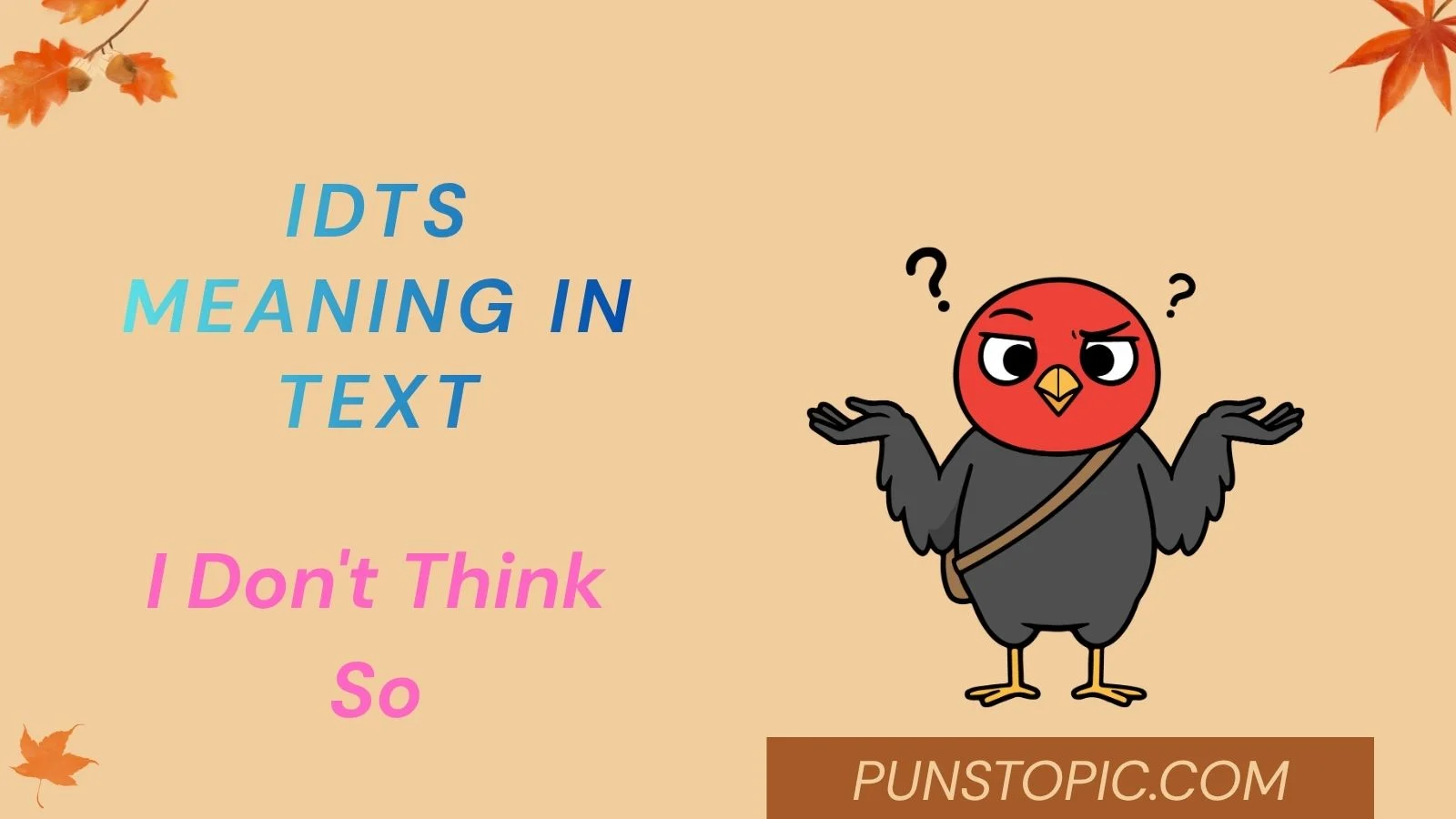
In texting and online chats, IDTS usually means:
“I Don’t Think So.”
People use it when they disagree with something, are unsure about a statement, or want to politely say “no.”
The phrase is often used in casual conversations where typing a short abbreviation is faster than writing the full sentence.
Quick Examples
- “Do you think it will rain today?”
- “IDTS.”
- “Is he coming to the party?”
- “IDTS.”
- “Will the exam be canceled?”
- “IDTS.”
The tone of IDTS can vary depending on the conversation.
It may sound:
- Casual
- Friendly
- Skeptical
- Doubtful
- Slightly dismissive
Because text messages lack facial expressions and voice tone, context matters when interpreting IDTS.
Full Form, Stands For & Short Meaning of IDTS
The full form of IDTS is:
I Don’t Think So
Word Breakdown
- I = The person speaking
- Don’t = Negative form of “do”
- Think = Believe or assume
- So = Referring to a previous statement
Together, the phrase means:
“I do not believe that is true.”
Short Meaning
IDTS is a quick way to express:
- Doubt
- Disagreement
- Uncertainty
- A negative opinion
Unlike a direct “No,” IDTS often sounds softer and less harsh.
For example:
- “Will prices drop tomorrow?”
- “IDTS.”
This suggests uncertainty rather than absolute certainty.
Origin, History & First Known Use of IDTS
Like many internet abbreviations, IDTS emerged from the early days of online communication.
As chat rooms, instant messaging services, and text messaging became popular, users looked for faster ways to communicate. Long phrases were shortened into acronyms to save time and character space.
During the late 1990s and early 2000s, abbreviations such as:
- LOL
- BRB
- IMO
- IDK
became widely used.
IDTS followed the same pattern by shortening “I Don’t Think So” into four letters.
The abbreviation gained popularity through:
- SMS texting
- Online forums
- Gaming chats
- Social media messaging
Today, it remains a recognizable slang term among internet users, especially younger audiences and frequent texters.
How People Use IDTS in Daily Conversations
IDTS appears in many everyday situations.
People often use it when they:
Express Doubt
- “Will he finish the project today?”
- “IDTS.”
Politely Disagree
- “That movie was the best of the year.”
- “IDTS.”
Show Uncertainty
- “Do you think the store is open?”
- “IDTS.”
Reject a Suggestion
- “Should we leave at midnight?”
- “IDTS.”
The abbreviation helps keep conversations short and informal.
Common Situations
- Group chats
- Friend conversations
- Gaming discussions
- Social media comments
- Casual texting
Because it is concise, people often prefer IDTS over typing the full phrase.
IDTS Meaning Across WhatsApp, Instagram, TikTok & Snapchat
While the core meaning remains the same, usage can vary slightly across platforms.
On WhatsApp, IDTS usually expresses doubt or disagreement.
Example:
- “Will Ahmed arrive before 8?”
- “IDTS.”
Users may use IDTS in comments or direct messages.
Example:
- “Is this the best restaurant in town?”
- “IDTS.”
TikTok
TikTok users often use IDTS when reacting to claims, opinions, or trends.
Example:
- “This challenge is easy.”
- “IDTS 😂”
Snapchat
Snapchat conversations are usually quick and casual.
Example:
- “Think she’ll reply?”
- “IDTS 😅”
Across all platforms, the meaning stays consistent: “I Don’t Think So.”
Different Meanings of IDTS in Other Fields
Although “I Don’t Think So” is the most common meaning, abbreviations can have alternative interpretations in specialized contexts.
Possible alternative meanings may appear in:
- Technical discussions
- Internal company communication
- Industry-specific terminology
However, in everyday texting and social media, IDTS almost always means:
I Don’t Think So
If you’re unsure, consider:
- The conversation topic
- The sender
- The platform being used
Context will usually reveal the intended meaning.
Common Confusions, Mistakes & Wrong Interpretations
Many people misunderstand IDTS when they first encounter it.
Common Mistakes
Thinking It Means “I Did This”
This is incorrect.
Assuming It Means “I Don’t Talk Sometimes”
This is also incorrect.
Confusing It With IDK
IDK means:
I Don’t Know
IDTS means:
I Don’t Think So
These phrases express different ideas.
Comparison
- IDK = Lack of knowledge
- IDTS = Lack of belief or confidence
Understanding the difference prevents confusion in conversations.
Similar Terms, Alternatives & Related Slang
Several internet abbreviations have meanings similar to IDTS.
IDK
- I Don’t Know
IMO
- In My Opinion
TBH
- To Be Honest
NGL
- Not Gonna Lie
Nope
- Informal way of saying no
Probably Not
- Similar meaning but written out
Doubt It
- Expresses skepticism
People often choose between these phrases depending on the tone they want to convey.
Examples of IDTS in Real Chat Situations
Here are realistic examples showing how IDTS appears in messages.
Example 1
Friend 1: Think we’ll get a holiday tomorrow?
Friend 2: IDTS 😅
2
Alex: Is that rumor true?
Sam: IDTS.
3
Mia: Will the concert be canceled?
Ryan: IDTS. Weather looks fine.
4
Emma: Do you think he forgot?
Jake: IDTS. He’s usually on time.
5
Chris: Is this game ending soon?
Ben: IDTS 😂
These examples show how naturally IDTS fits into everyday conversations.
How to Reply When Someone Says IDTS
When someone sends IDTS, your response depends on the situation.
1 If You Want More Details
- “Why not?”
- “What makes you think that?”
2 If You Agree
- “Yeah, probably not.”
- “I think you’re right.”
3 If You Disagree
- “Maybe, but we’ll see.”
- “I think there’s still a chance.”
4 If You’re Joking
- “Watch me prove you wrong 😂”
- “Challenge accepted 😎”
The best response depends on the tone and context of the conversation.
Is IDTS Still Popular? Trends & Online Usage
Yes, IDTS is still used online today.
Although newer slang terms appear regularly, many classic abbreviations remain common because they are:
- Easy to type
- Easy to understand
- Widely recognized
IDTS continues to appear in:
- Text messages
- Group chats
- Gaming communities
- Social media comments
- Direct messages
However, some users now prefer writing the full phrase “I don’t think so” because modern keyboards make typing faster than ever.
Even so, IDTS remains a useful and recognizable internet abbreviation.
Internal Linking Suggestions
For better SEO and user engagement, consider linking this article to related pages such as:
- IDK Meaning in Text
- IMO Meaning in Text
- TBH Meaning in Text
- NGL Meaning in Text
- SMH Meaning in Text
- WYLL Meaning in Text
- FR Meaning in Text
- ILY Meaning in Text
Why People Use IDTS Instead of Typing the Full Phrase
Texting is all about speed and convenience. IDTS allows users to express doubt or disagreement in just four letters. Many people prefer abbreviations because they make conversations faster and feel more casual. In group chats and social media discussions, short forms help keep the conversation moving without long explanations.
Common reasons people use IDTS include:
- Faster typing
- Casual communication style
- Mobile-friendly texting
- Widely understood internet slang
- Quick response during busy conversations
Because the phrase is so simple, many users instantly recognize it even if they do not regularly use internet slang.
The Tone Behind IDTS: Friendly, Neutral, or Rude?
The meaning of IDTS can change slightly depending on the tone of the conversation. While the words themselves simply mean “I Don’t Think So,” the way they are used can affect how the message is received.
For example:
- Friendly: “IDTS 😄”
- Neutral: “IDTS.”
- Dismissive: “IDTS lol”
Without voice or facial expressions, readers often rely on punctuation and emojis to understand the intended tone. Adding an emoji can make the response feel softer and more approachable.
When You Should Avoid Using IDTS
Although IDTS is common in casual conversations, it is not appropriate everywhere. Professional emails, academic writing, and formal business communication generally require complete sentences.
Situations where you should avoid IDTS:
- Job applications
- Business emails
- School assignments
- Professional presentations
- Customer service communication
Instead, use the full phrase “I don’t think so” or provide a more detailed explanation.
Generational Differences in Understanding IDTS
Different age groups often have varying levels of familiarity with internet abbreviations. Younger users who spend time on social media typically understand IDTS immediately, while older users may need clarification.
This difference occurs because online slang evolves quickly. New abbreviations become popular among younger audiences before spreading to broader groups.
As digital communication becomes more common, terms like IDTS continue to gain recognition across multiple generations.
How IDTS Compares to Other Negative Responses
IDTS is only one way to express disagreement online. Several alternatives exist, each with a slightly different tone.
IDTS
Suggests doubt or uncertainty.
No
Direct and clear rejection.
Nope
Casual and friendly refusal.
Probably Not
Less certain than a direct no.
I Doubt It
Stronger skepticism.
Choosing the right response depends on the conversation and relationship between the people involved.
Signs That Someone Is Skeptical When Using IDTS
People often use IDTS when they are not fully convinced about a statement, prediction, or rumor. The abbreviation acts as a quick indicator of skepticism.
Examples include:
- Questioning news or gossip
- Doubting future events
- Challenging predictions
- Disagreeing with assumptions
In these situations, IDTS communicates uncertainty without starting an argument.
Can IDTS Have a Positive Meaning?
In most cases, IDTS carries a negative or doubtful meaning because it expresses disbelief. However, context can make the outcome positive.
For example:
“Do you think we’ll fail the exam?”
“IDTS 😊”
Although the abbreviation still means “I Don’t Think So,” the overall message becomes encouraging because the speaker believes failure is unlikely.
This shows why context is important when interpreting online slang.
IDTS in Online Gaming and Digital Communities
Gamers frequently use abbreviations to communicate quickly during matches. IDTS appears in gaming chats when players discuss strategies, predictions, or outcomes.
Examples:
- “Will they win this round?”
- “IDTS.”
- “Think the boss fight is easy?”
- “IDTS 😂”
Fast-paced environments encourage the use of shortcuts, making abbreviations like IDTS especially useful.
How Context Changes the Meaning of IDTS
While the definition remains the same, the intended message can vary depending on the discussion.
Consider these examples:
- “Will it rain?” → Weather prediction.
- “Is that story true?” → Doubt about information.
- “Will they break up?” → Personal opinion.
- “Can we finish today?” → Concern about progress.
The surrounding conversation determines exactly what the speaker is doubtful about.
Future of IDTS and Internet Slang
Internet language constantly evolves. Some abbreviations disappear over time, while others remain popular for decades. IDTS has survived because it is simple, practical, and easy to understand.
As messaging apps continue to dominate communication, concise expressions will likely remain valuable. Even if new slang emerges, IDTS is likely to stay recognizable among online users for years to come.
Quick Facts About IDTS
- Full form: I Don’t Think So
- Commonly used in texting and chat
- Expresses doubt or disagreement
- Popular on social media platforms
- Usually informal in tone
- Often paired with emojis for clarity
- Recognized by most frequent internet users
FAQs:
What does IDTS mean in texting?
IDTS stands for “I Don’t Think So” and is used to express doubt, disagreement, or uncertainty.
Is IDTS rude?
Not usually. It is generally considered a casual and softer alternative to saying “No.”
What is the full form of IDTS?
The full form of IDTS is “I Don’t Think So.
Is IDTS commonly used on Snapchat?
Yes. Snapchat users frequently use IDTS in casual conversations and replies.
What’s the difference between IDTS and IDK?
IDTS means “I Don’t Think So,” while IDK means “I Don’t Know.”
Can IDTS be used professionally?
It is best suited for casual conversations. In professional communication, writing the full phrase is usually more appropriate.
Is IDTS still popular in 2026?
Yes. While some users type the full phrase, IDTS remains a recognized and widely understood abbreviation online.
Conclusion:
Understanding the IDTS meaning in text is simple once you know that it usually stands for “I Don’t Think So.” People use it to express doubt, disagreement, or uncertainty in a quick and casual way. The abbreviation appears across texting apps, social media platforms, gaming chats, and everyday online conversations.
Whether you see IDTS on WhatsApp, Instagram, TikTok, or Snapchat, the meaning is generally the same. Knowing this common internet slang can help you understand conversations more clearly and communicate more naturally online.
As digital language continues to evolve, abbreviations like IDTS remain useful because they save time while conveying a clear message. The next time someone replies with IDTS, you’ll know exactly what they mean and how to respond confidently.